All Categories
Featured
Table of Contents
Risks are tilted to the disadvantage. In the occasion of a prolonged dispute, the present influence on the region will be compoundedthrough elevated energy and food rates, decreasing trade, tourist and remittances, increased fiscal pressures, and displacement. "The present crisis is a plain reminder of the work ahead for the region: not only to weather shocks, however to reconstruct more resilient economies with stronger macroeconomic basics, innovate and enhance governance, purchase infrastructure, and enhance employment-creating sectors," said.
With peace and the right action, countries can develop the organizations, capabilities and competitive sectors that create chances for people." With this long-lasting vision in mind, the report takes a close take a look at the region's capacity for commercial policy government actions to increase strategic organization activity as a driver of financial growth and job production.

Federal governments in the area have embraced commercial policy at a high rate in the last decade, typically through sovereign wealth funds and state-owned enterprises, but the outcomes have been blended. The report highlights the vital need for strong organizations and cautious targeting of policies. "As nations face the heavy toll of the present dispute, it is necessary to also not forget the work needed for long-lasting peace and prosperity," said.
Key Equity Market Strategies for Regional Growth
Q2 2026: The ICAEW Economic Update Middle East, is a quarterly economic forecast for the area prepared straight for the finance profession. The GCC economy deals with a marked contraction this year pending details of the US-Iran arrangement to end the war. We anticipate energy circulations, tourist and financier belief to slowly normalise as war interruptions decrease.
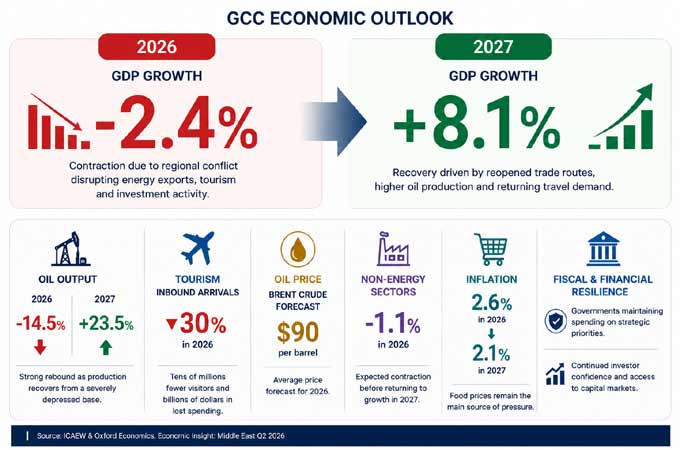
The interim contract in between the US and Iran is a significant step towards reaching a full-blown offer. A complete go back to normality in the Strait of Hormuz will likely take time, however the risk of a recession-inducing oil rate spike has actually decreased. International GDP is expected to grow by 2.4% this year, 0.2 ppt less than we predicted 3 months back, and 3.1% in 2027.
We anticipate a 4.1% contraction in Middle East GDP this year (versus forecasted 3.6% growth before the war), higher than the decline in the very first year of the Covid pandemic. Kuwait, Iran, Iraq and Qatar stick out as the hardest struck, owing to their failure to avoid the interruption to local shipping, war-driven facilities damage and tourist losses.
Integrating ESG into the Core of Gulf Business ModelsOur 2026 outlook for the GCC is weaker than three months back, with GDP forecast to agreement by 2.4% compared to a 0.2% decline predicted formerly. We anticipate Oman and Saudi Arabia to be the least negatively impacted by the fallout from the dispute, with both economies continuing to broaden this year.
The economic damage incurred in the last few months is considerable. Saudi GDP data for Q1 showed development slowed to 3% y/y, with non-oil activities broadening by 2.9%, the weakest pace because the Covid pandemic. On a seasonally adjusted basis, GDP contracted 1.2% q/q, driven by a 6.8% fall in oil activities as the Strait of Hormuz interruption struck late in the quarter.
2026 Business Climate in the GCC
Aside from Oman, all GCC producers along with Iran and Iraq have suffered extensive oil and gas production losses considering that the start of the conflict. Might data reveal local production nearly halved from pre-war levels, with the decline deepening relative to March and April. Rerouting efforts, consisting of by Saudi Arabia through the East-West Pipeline and the UAE through the Habshan-Fujairah pipeline, have helped avoid an even larger plunge in output.

Nonetheless, we forecast GCC oil sector output to agreement by 14.5% this year, which will mark the steepest decrease in a number of decades. We then expect a 23.5% rebound next year, driven mostly by normalisation from a severely depressed base. On the other hand, oil rates have actually been unstable, alleviating listed below $85 per barrel as the interim arrangement was revealed.
In the medium term, we expect oil costs to be somewhat lower than our pre-war standard, as the UAE's departure from OPEC+ enables for a gradual increase in its output towards the 5mn barrel per day production target when trade normalises. Versus this background, the UAE will accelerate the building and construction of a brand-new West-East pipeline that need to double the capacity of export through Fujairah.
The May PMI surveys reported output growth reaching its greatest level in 3 months, driven mostly by improved domestic demand. However, they remain below long-run averages, with weak export orders and cost pressures from greater product and transport costs are a typical theme. Overall, we anticipate a 1.1% contraction in GCC non-energy sectors this year (compared to 4.2% growth pre-war) and a progressive healing over the remainder of the decade.

Latest Posts
Roadmap to GCC Financial Market Trends for 2026
Current GCC Stock Market Patterns to Watch
Ways to Leverage International Capital Potential in 2026